HSI Opens Lower, Moves Higher; Domestic Sectors Take Over Lead
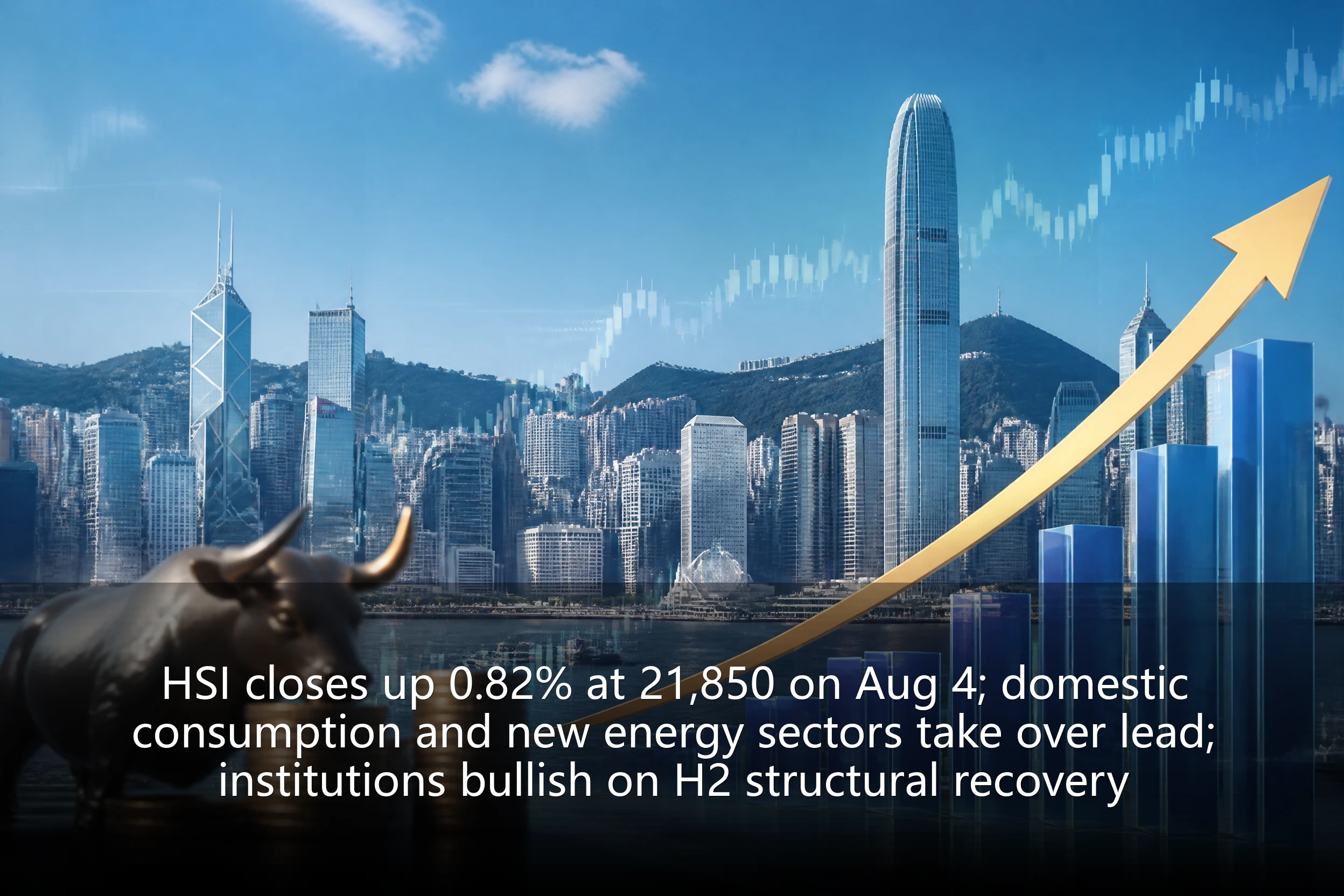
On August 4, 2026, the Hang Seng Index quickly rebounded after a slight dip at the open, closing at 21,850 points, up 178 points or 0.82% for the day. This marks the second consecutive rebound session after the index faced resistance near the 22,500 level last week, with market sentiment clearly warming. Notably, today's leadership shifted from previously dominant tech stocks to domestic consumption and new energy sectors, reflecting orderly rotation among sectors.
On the sector front, restaurant chains, sportswear, and new energy vehicle supply chain stocks performed strongly. Haidilao (06862.HK) surged 5.3%, Anta Sports (02020.HK) rose 4.8%, and BYD Company (01211.HK) closed up 3.6%. Meanwhile, previously high-flying AI concept and semiconductor stocks saw profit-taking, with SenseTime (00020.HK) down 2.1% and SMIC (00981.HK) edging 0.8% lower. This ebb and flow between sectors is a typical feature of the HSI consolidating at current levels.
Southbound Funds Net Inflow for 9th Day, Providing Key Support
Capital flows provided the strongest support for today's market. According to HKEX data, southbound funds recorded a net inflow of HKD 5.2 billion today, marking the ninth consecutive trading day of net inflows, with cumulative net inflows exceeding HKD 38 billion. This sustained inflow not only offsets some foreign capital profit-taking pressure but also reflects mainland investors' recognition of the current valuation levels in Hong Kong stocks.
In terms of flow structure, today's southbound buying focused on consumer leaders and new energy vehicle makers, highly consistent with the index performance. Tencent Holdings (00700.HK) saw net buying of HKD 820 million, Meituan (03690.HK) net buying of HKD 560 million, and BYD net buying of HKD 430 million. The continuous improvement in capital flows has built a solid support platform for the HSI in the 21,800–22,000 range.
Macro Environment Improves Marginally; Domestic Demand Policy Expectations Rise
At the macro level, the market is digesting multiple positive signals. The Central Economic Work Conference concluded last week signaled further expansion of domestic demand, with the market expecting more stimulus measures targeting consumption, automobiles, and home appliances in the second half. Meanwhile, the Federal Reserve held rates steady at its August meeting, and the dot plot showed a significantly reduced probability of rate hikes this year, providing a favorable external environment for HSI valuation repair.
Analysts note that the HSI is currently in a relatively favorable macro window. Expectations of mainland policy easing combined with the nearing end of the Fed's rate hike cycle are gradually materializing as dual tailwinds. However, investors still need to watch for potential disruptions from US-China relations, geopolitics, and other uncertainties. From a technical perspective, the HSI has formed a strong support zone near 21,800 points; if it can effectively break through the 22,000 integer mark, it could challenge the 22,500 area.
H2 Structural Opportunities: Focus on Domestic Demand and Green Transition
Looking ahead to the second half, multiple institutions have released strategy reports broadly bullish on structural opportunities in Hong Kong stocks. CITIC Securities research notes that earnings growth for consumer, new energy, and pharmaceutical sectors within HSI constituents is expected to inflect in H2, advising investors to focus on three main themes: consumer leaders benefiting from domestic demand recovery, new energy vehicle and photovoltaic supply chains benefiting from the global energy transition, and tech innovation enterprises supported by policy.
CICC emphasizes that HK stock valuations remain at historically low percentiles, with the HSI forward P/E around 11.5x, below the five-year average. Driven by both improving capital flows and gradually recovering fundamentals, there is room for valuation re-rating in the HSI during H2. However, investors should pay attention to sector rotation rhythm, avoid chasing highs, and adopt a buy-on-dips strategy, focusing on high-quality targets with high earnings certainty.
HSI Investment Strategy: Grasp Rotation Rhythm, Emphasize Risk Control
For investors, the current HSI market exhibits clear structural characteristics. Accelerated sector rotation requires more flexible operational strategies. Technical analysis shows the HSI MACD indicator has a golden cross near the zero line, with RSI remaining in a neutral-to-strong zone, indicating a short-term bullish bias. However, the index faces prior high resistance near 22,500 points, and whether it can effectively break through still depends on volume confirmation.
In terms of trading strategy, investors are advised to watch the following key levels: support near 21,500 points, resistance at 22,200 and 22,500 points. If the index breaks above 22,200 with expanding volume, positions can be moderately increased; if it consolidates with shrinking volume, it is better to stay on the sidelines. Meanwhile, using HSI ETFs for phased accumulation is a relatively prudent approach in the current environment. For investors with higher risk tolerance, leveraged tools such as HSI CBBCs can be considered, but positions must be strictly controlled to guard against market volatility risks.
Overall, the Hong Kong stock market in August 2026 is at a critical transitional stage. After the consolidation in the first half, the HSI is expected to see structural opportunities in the second half. Investors should closely monitor the pace of policy implementation, changes in capital flows, and the evolving external environment, seizing opportunities while managing risks effectively.