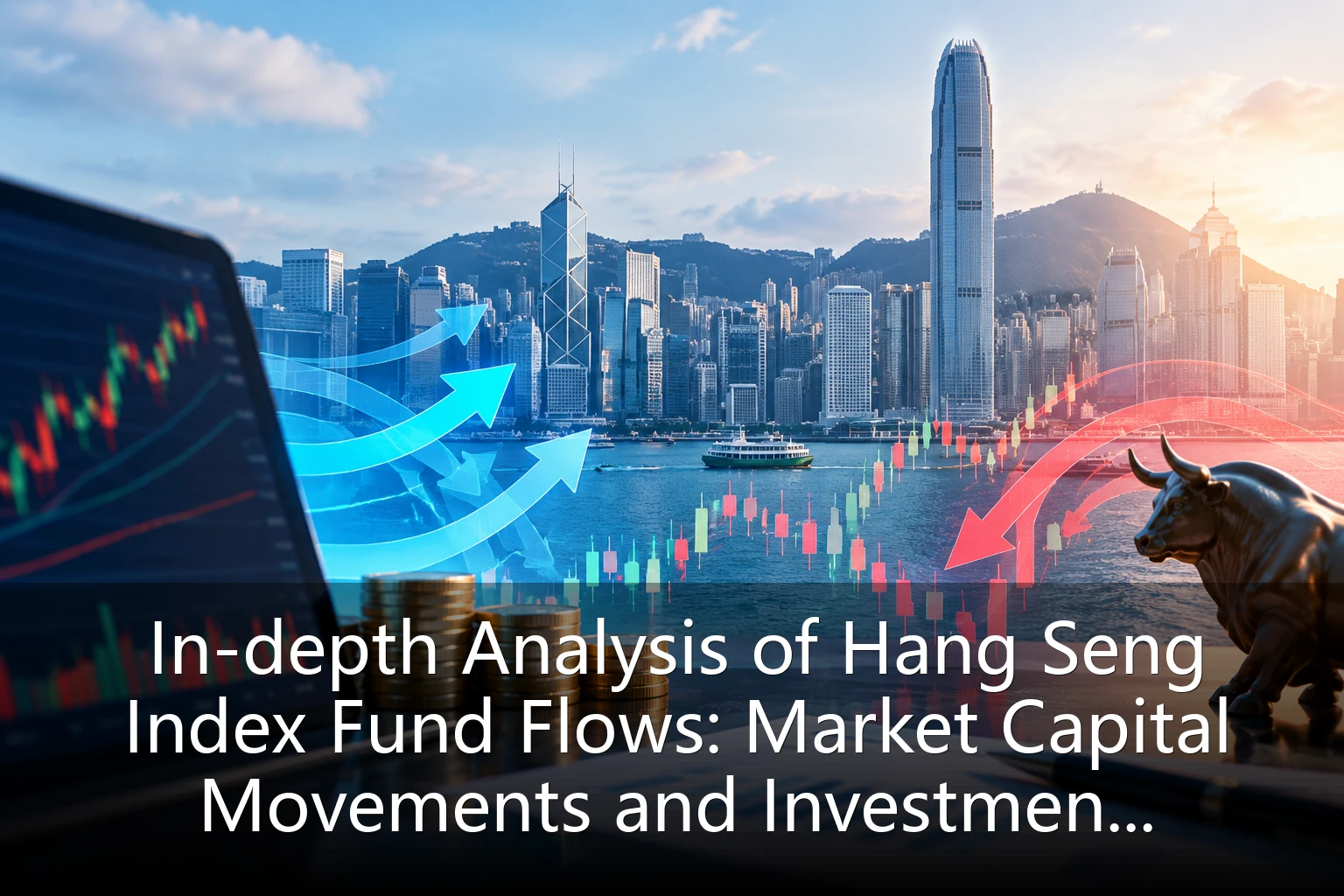
In-depth Analysis of Hang Seng Index Fund Flows: Market Capital Movements and Investment Strategies for October 2026
In early October 2026, global financial markets presented a complex situation under the influence of multiple factors. As an important market indicator in the Asia-Pacific region, the Hang Seng Index's fund flow changes have attracted significant attention from investors. This article will conduct an in-depth analysis of recent HSI fund flow characteristics, interpret the logic behind market capital movements, and provide investors with HSI investment strategy recommendations based on fund flows.
The Importance of Monitoring Hang Seng Index Fund Flows
Monitoring HSI fund flows is an important tool for investors to grasp market sentiment and predict future trends. Fund flows reflect the overall attitude of market participants towards the Hong Kong stock market. By analyzing changes in fund distribution across different sectors and among different types of investors, market structural changes can be anticipated in advance, providing important references for investment decisions.
In early October 2026, HSI fund flows showed several significant characteristics: first, southbound funds continued to show net inflows, indicating increased confidence of mainland investors in the Hong Kong stock market; second, northbound funds showed a divergent trend, with some international institutions increasing holdings in financial and technology stocks while reducing positions in real estate and energy sectors; third, ETF funds showed a net subscription trend, indicating that institutional investors are generally optimistic about the Hong Kong stock market.
Southbound Funds: Mainland Capital Continues to Flow In, Focus on New Economy Sectors
In early October 2026, southbound funds (mainland capital investing in Hong Kong stocks through the Stock Connect program) maintained a net inflow trend, with daily net inflows stabilizing in the range of 5-8 billion Hong Kong dollars. From the perspective of capital allocation direction, southbound funds mainly flowed into the following sectors:
- Technology stocks: Mainland investors continued to increase holdings of technology leaders such as Tencent, Alibaba, and Meituan, reflecting confidence in Hong Kong's new economy sectors
- Financial stocks: Banking and insurance sectors gained favor from southbound funds, especially state-owned banks with valuation advantages and stable dividend capabilities
- Consumer stocks: As expectations for mainland consumption recovery strengthened, southbound funds increased allocation to the consumer sector
- High-dividend assets: Against the backdrop of declining interest rates, southbound funds increased allocations to stocks with stable dividend capabilities
The continuous inflow of southbound funds is mainly driven by several factors: first, the deepening reform of the mainland capital market and continuous improvement of the Stock Connect mechanism; second, the increasingly close interconnection between Hong Kong and mainland financial markets; third, the significant valuation advantages of some Hong Kong sectors, especially quality stocks with discounts compared to A-shares.
Northbound Funds: International Institutions Adjust Positions, Focus on Quality Assets
Different from southbound funds, northbound funds (international investors investing in mainland stocks through the Stock Connect program) showed a divergent trend in early October 2026. Overall, northbound funds maintained a stable allocation ratio to the Hong Kong stock market, but showed significant adjustments in sector selection:
- Sectors with increased holdings: International institutional investors increased holdings of technology leaders with global competitiveness, consumer stocks benefiting from mainland economic recovery, and fairly valued financial stocks
- Sectors with reduced holdings: Some international investors reduced positions in cyclical real estate and energy sectors, shifting to more defensive assets
- New economy sectors: The allocation ratio of northbound funds to Hong Kong new economy enterprises continued to increase, especially those with technological innovation capabilities and global market share
The trend of northbound funds reflects changing attitudes of international investors towards the Hong Kong stock market. On one hand, as the internationalization of the Hong Kong market improves, international investors' understanding of Hong Kong stocks continues to deepen; on the other hand, increasing global geopolitical and economic uncertainties have prompted international investors to pay more attention to asset quality and risk control.
ETF Funds: Institutional Investors Optimistic About Long-term Value of Hong Kong Stocks
In early October 2026, Hong Kong-related ETFs showed a net subscription trend, indicating that institutional investors are generally optimistic about the Hong Kong stock market. From the perspective of ETF fund flows, the following characteristics are worth noting:
- HSI ETFs: ETFs tracking the Hang Seng Index showed stable net inflows, reflecting institutional investors' confidence in the overall prospects of the Hong Kong stock market
- Technology ETFs: Hong Kong technology sector ETFs received net fund subscriptions, showing investors' optimism towards technology stocks
- High-dividend ETFs: In a low-interest rate environment, high-dividend strategy ETFs received fund favor
- Volatility index-related ETFs: As market volatility increased, demand for volatility hedge-related ETFs rose
Changes in ETF fund flows provide important references for investors. As an important tool for institutional investors to allocate Hong Kong stocks, ETF fund flows often lead to individual stock movements and can reflect institutional investors' overall judgment of the market in advance.
The Relationship Between HSI Fund Flows and Market Trends
There is a close relationship between fund flows and HSI trends. Analysis of historical data shows that when funds continue to flow in, the HSI often shows an upward trend; when funds flow out, the HSI may face adjustment pressure. The impact of early October 2026 fund flow changes on HSI trends is mainly reflected in the following aspects:
- Index support: Continuous inflow of southbound funds provides strong support for the HSI, especially during market corrections
- Sector rotation: Fund flows between different sectors drive structural adjustments within the HSI, causing the index to show certain sector rotation characteristics
- Volatility changes: Changes in fund flows are often accompanied by adjustments in market volatility, providing opportunities for volatility trading
It is worth noting that the impact of fund flows on the HSI has a certain time lag. Usually, the impact of fund inflows gradually manifests after 1-2 months. Investors need to consider this time factor when analyzing fund flows.
HSI Investment Strategies Based on Fund Flows
Based on the analysis of HSI fund flows in early October 2026, we propose the following investment strategy recommendations:
1. Track Fund Flows and Grasp Structural Opportunities
Investors should closely monitor changes in fund flows, especially the main flow sectors of southbound and northbound funds. Current data shows that technology, finance, and high-dividend sectors are receiving fund favor, and these sectors may have structural opportunities. Investors can appropriately increase allocations to these sectors, but at the same time need to pay attention to risk control.
2. Use ETF Tools to Diversify Investment Risks
For ordinary investors, investing in Hong Kong-related ETFs can indirectly participate in HSI investment while diversifying individual stock risks. According to fund flow trends, different types of ETF products such as HSI ETFs, technology ETFs, or high-dividend ETFs can be selected to construct an investment portfolio that matches their own risk preferences.
3. Pay Attention to Changes in Fund Flows and Adjust Investment Strategies in a Timely Manner
Fund flows are dynamically changing, and investors need to continuously monitor the changing trends of fund flows and adjust investment strategies in a timely manner. Especially when the market undergoes major turning points, changes in fund flows often signal changes in market trends. Investors should pay close attention and adjust positions appropriately.
4. Combine Technical Analysis to Improve Investment Accuracy
Fund flow analysis needs to be combined with technical analysis to improve the accuracy of investment decisions. Investors can use HSI technical indicators such as moving averages, relative strength index, etc., to judge market trends, and combine them with changes in fund flows to formulate more precise trading strategies.
5. Pay Attention to Seasonal Characteristics of Fund Flows
Historical data shows that HSI fund flows have certain seasonal characteristics. For example, at the beginning and end of the year, institutional investors often adjust positions, leading to significant changes in fund flows. When formulating investment strategies, investors should consider these seasonal factors and avoid blind following.
Risk Warnings and Investment Recommendations
Although fund flow analysis has important reference value for investment decisions, investors also need to pay attention to the following risks:
- Fund flows may be affected by unexpected events, causing short-term sharp fluctuations
- The investment motivations of different fund sources may differ, and relying solely on fund flow analysis may have limitations
- Changes in market sentiment may cause fund flows to deviate from fundamentals
Overall, the HSI fund flows in early October 2026 show a positive trend, with southbound funds continuously flowing in and international investors increasing allocations to Hong Kong's new economy sectors. While grasping these capital movements, investors should conduct comprehensive analysis combining macroeconomic environment, industry development trends, and corporate fundamentals to formulate investment strategies that match their own risk preferences.
Looking ahead, as the interconnection between Hong Kong and mainland financial markets deepens and the internationalization of the Hong Kong stock market increases, the impact of fund flows on HSI trends will become more significant. Investors should continue to monitor changes in fund flows, flexibly adjust investment strategies, and effectively control risks while seizing market opportunities.
In conclusion, monitoring HSI fund flows is an important tool for investors to grasp market dynamics and formulate investment strategies. Through in-depth analysis of changes in fund flows, investors can better understand market sentiment, capture structural opportunities, and achieve long-term stable investment returns.