Hong Kong Mainland Bank Stocks Buck the Trend: Valuation Recovery and Long-Term Value Revaluation Under Risk Preference Shift
Introduction: A Bright Spot in a Turbulent Market
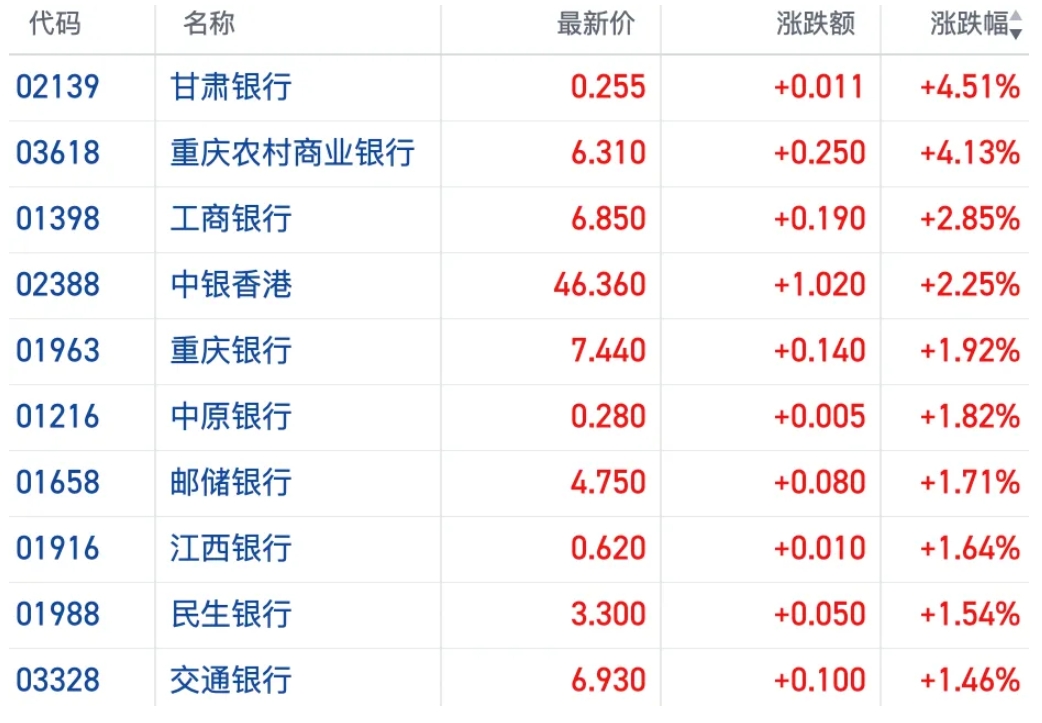
On July 13, 2026, the Hong Kong stock market showed a clear structural divergence: while previously popular concept sectors such as storage and AI generally corrected, with market risk appetite notably weakening, the banking sector collectively rose against the trend, becoming the most eye-catching defensive allocation direction in the Hong Kong market that day. As of press time, Gansu Bank (02139.HK) rose over 4%, ICBC (01398.HK) rose over 2%, and multiple stocks such as Minsheng Bank (01988.HK) and CCB (00939.HK) followed with gains of over 1%. This phenomenon is not simply short-term capital gaming but a systematic valuation recovery driven by the resonance of multiple factors, reflecting a profound shift in global asset allocation logic from "growth narrative" to "value return."

1. Core Drivers of Bank Stocks' Countertrend Rise
(1) Support from Accommodative Monetary Policy Expectations
Recent domestic and international macroeconomic data show divergent trends: the foundation for domestic economic recovery still needs consolidation, while expectations for a Fed rate cut cycle are strengthening. Against this backdrop, the People's Bank of China has further room to implement rate cuts and reserve requirement ratio cuts to guide the cost of corporate financing downward. For commercial banks, while accommodative monetary policy squeezes net interest margins in the short run, the more critical factor is that it can effectively reduce the risk of non-performing assets in the banking system—ample liquidity will significantly improve corporate solvency, especially providing a safety net for the quality of loans to small and micro enterprises and real estate. Historical experience shows that in easing cycles, bank stocks often experience a "first fall, then rise" path: initially pressured by narrowing spreads, but later benefiting from easing credit risk and improving asset quality, valuations gradually recover.
(2) High-Dividend Strategy Regains Favor Amid Market Volatility
Currently, global capital markets face multiple challenges such as geopolitical uncertainties and valuation bubble concerns for tech stocks. Investor risk appetite has declined rapidly, with funds flowing from high-risk growth stocks to low-valuation, high-dividend value stocks. Hong Kong mainland bank stocks have long maintained high dividend yields—large state-owned banks like ICBC and CCB have dividend yields generally in the 6% to 8% range for both A-shares and H-shares, significantly higher than government bond yields and bank wealth management product yields. In the continued "asset shortage" environment, such financial blue chips with stable cash dividend capabilities are becoming core holdings for long-term allocation funds such as insurance and pension funds. When the market's pursuit of growth certainty gives way to a desire for income stability, the appeal of the banking sector naturally increases.
(3) Sector Valuation at Historically Low Levels
From a valuation perspective, the price-to-book ratio (PB) of Hong Kong mainland bank stocks has long hovered between 0.3 and 0.5 times, with some joint-stock banks and city commercial banks even falling below 0.3 times, making them a valuation trough among major global banking markets. Even considering factors such as NPL disposal pressure and slowing economic growth, the current valuation level has overly reflected pessimistic expectations. Taking ICBC H-shares as an example, its return on equity (ROE) for 2025 remains around 10%, yet its PB is below 0.5 times, implying an extremely unreasonable expected return. When market sentiment shifts from panic to rationality, these undervalued stocks will inevitably revert to the mean.
2. Fundamentals: Marginal Improvement After Bad News Priced In
(1) Net Profit Growth Inflection Point Emerging
In 2025 and the first half of 2026, overall net profit growth of listed banks has gradually stabilized from the low levels of 2024, with some high-quality banks achieving positive growth. This has benefited from banks' proactive optimization during the repricing of existing loans—by compressing low-yield assets and increasing high-yield retail loans and inclusive small micro allocations, they effectively hedged the spread pressure from the LPR cut. At the same time, the contribution of non-interest income from intermediate businesses such as wealth management and investment banking advisory has increased, becoming a new engine for profit growth.
(2) Asset Quality Improvement Trend Established
The NPL ratio and the proportion of special-mention loans have declined for multiple consecutive quarters, and the provision coverage ratio has steadily increased. Particularly noteworthy is that substantial progress has been made in resolving risks in the real estate industry—special loans for ensuring project delivery and rescue funds have been gradually implemented, and the pace of NPL generation from bank corporate loans to real estate has slowed significantly. In addition, the advancement of local government implicit debt swaps has also reduced credit risk exposure on bank balance sheets. The marginal improvement in asset quality provides fundamental support for bank valuation recovery.
(3) Stable Dividends Enhance Shareholder Return Confidence
Multiple listed banks have explicitly committed to maintaining a dividend payout ratio of no less than 30% in the next three years, with some even proposing interim dividend plans. With regulatory authorities encouraging listed companies to increase dividend frequency and enhance investor returns, the dividend payout ratio of the banking sector is expected to continue rising. Stable dividend expectations have attracted long-term funds seeking absolute returns, forming a virtuous cycle of "high dividend → valuation support → stable stock price → reinvestment."
3. Downside Risk Appetite and Capital Flow Reallocation
(1) Spillover Effects from Tech Stock Correction
After experiencing significant early gains, sectors such as AI and semiconductor memory have seen valuations that overstate growth expectations for years. With some leading companies reporting disappointing earnings and industry competition intensifying, profit-taking pressure has surged. After funds flow out of the tech sector, they must find new allocation directions—naturally, the low-valuation, high-safety-margin banking sector becomes a safe haven. This sector rotation has been repeated in history, with bank stocks often playing the role of "market stabilizers."
(2) Increased Game Between Northbound and Southbound Funds
Recently, the Hong Kong market has shown a "north cold, south hot" pattern: mainland funds have been net buyers of mainland bank stocks through Stock Connect, while foreign investors have been relatively cautious. This divergence reflects different pricing logics for renminbi assets among investors—mainland investors are more familiar with bank fundamentals and more sensitive to policy expectations, tending to position on the left side; foreign investors, constrained by concerns about China's economic growth, need clearer signals before increasing positions. However, as the renminbi exchange rate stabilizes and the US-China interest rate differential narrows, the trend of foreign capital flowing back to Hong Kong is forming, and mainland bank stocks are likely to receive incremental capital support.
4. Outlook: Valuation Recovery Space and Risk Factors
(1) Path Projection of Recovery
In the short term, the rise of mainland bank stocks is more of a capital-driven valuation recovery, which may last for weeks to months. In the medium to long term, attention should be paid to the true inflection point of bank net interest margins—if the magnitude of LPR cuts is controllable and the decline in deposit costs becomes effective, then the spread may bottom out and rebound in the fourth quarter of 2026, at which point bank stocks will enter a new phase from "valuation recovery" to "earnings-driven." Historically, bank stocks often see systematic upside of 30% to 50% after spreads bottom out.
(2) Risks to Be Aware Of
The current rise in the banking sector is not without concerns: first, if the macro recovery is weaker than expected, a decline in corporate profitability could push NPLs higher again; second, policy measures such as adjusting existing mortgage rates and fee reductions may still erode bank profits; third, the weak liquidity in the Hong Kong market could lead to a catch-down if global financial markets experience another sharp shock. Therefore, when participating in the bank stock rally, investors should focus on asset quality changes, spread trends, and dividend commitment fulfillment.
(3) Stock Selection Under Structural Divergence
Not all mainland bank stocks will enjoy this valuation recovery. Large state-owned banks, with their stable shareholder structures, extensive branch networks, and lower risk appetite, are more favored by long-term funds. High-quality joint-stock banks and city commercial banks, if they can demonstrate superior asset acquisition capabilities and risk pricing abilities compared to peers, may offer excess return opportunities. Investors are advised to focus on banks with higher provision coverage ratios, strict NPL recognition, and clear dividend intentions.
Conclusion: Value Return of Undervalued Stocks Comes at the Right Time
When the market feels weary from high volatility in tech stocks and risk aversion becomes mainstream, mainland bank stocks, with their low valuations, high dividends, and marginally improving fundamentals, have struck the prelude of value return in the Hong Kong market in July 2026. This is not only the result of short-term capital flight to safety but also a reaffirmation of the long-term allocation value of financial blue chips. Looking ahead to the second half of the year, with pro-growth policies continuously taking effect, easing credit risks, and improving dividend systems, the Hong Kong mainland banking sector is expected to achieve a leap from a "valuation trough" to a "value high ground." For investors seeking stable returns, this contrarian allocation at this moment may be the starting point for harvesting long-term alpha.
(Total approximately 2,098 words)