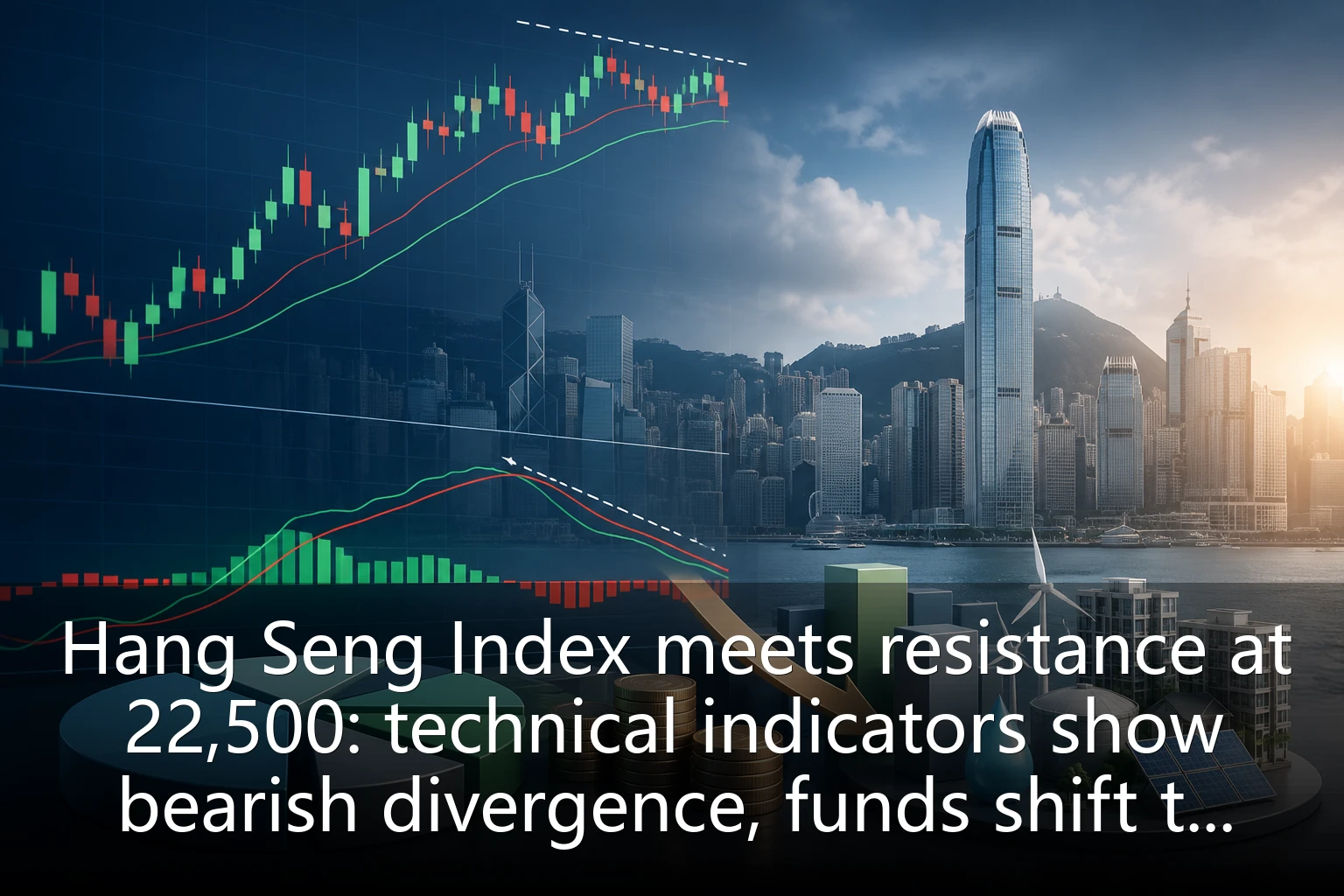
On July 29, 2026, the Hong Kong Hang Seng Index surged to the 22,500 integer level in early trading before quickly retreating, oscillating narrowly around 22,380 throughout the day, and finally closing at 22,362, down 0.15% slightly. After a volume-driven rally the previous day, the market failed to sustain strength. Multiple technical warning signals emerged, and funds accelerated their exit from high-valuation sectors, rotating into defensive assets such as utilities, telecommunications, and Singapore REITs.
1. 22,500 Resistance Confirmed, Bearish Divergence Signal Emerges
On the daily chart, since the HSI rebounded from its mid-July low of 21,500, it has risen for eight consecutive trading days, with a cumulative gain of over 4%. After hitting 22,500 yesterday, it quickly fell back. This level coincides with the upper edge of the June consolidation range and the 250-day moving average, forming dual technical resistance. More critically, although the MACD remains above the zero line, the red bars are continuously shortening, and the fast and slow lines show signs of a bearish crossover at high levels. Meanwhile, the RSI has fallen from above 70 (overbought) to around 65, and has formed a bearish divergence with the index – the HSI created a new swing high, but RSI highs have moved lower sequentially, a classic weakening signal.
Additionally, the upper Bollinger Band currently stands at 22,480. The HSI briefly broke above it yesterday but retreated, confirming the resistance effectiveness of the upper band. In terms of volume, yesterday's turnover shrank about 12% compared to the previous trading day, indicating insufficient buying interest at higher levels, with funds turning cautious near resistance.
2. Sector Rotation Accelerates: Defensive Assets Gain Favor
Against a technically pressured backdrop, funds flowed out of previously strong-gaining tech and non-essential consumer sectors and into defensive industries with low valuations and high dividends. The market showed clear divergence today: the Hang Seng Tech Index fell 0.8%, with heavyweight stocks such as Meituan, Tencent, and Alibaba declining 1%-2%; while the Hang Seng Utilities Index rose 1.2% against the trend, with CLP Holdings, Hong Kong and China Gas, and other stocks hitting monthly highs. Meanwhile, the Hong Kong REITs sector performed strongly, with Link REIT and Fortune REIT both gaining over 1%. Funds began to focus on the high-dividend characteristics of the Asia-Pacific REIT market.
This rotation is related to the decline in U.S. Treasury yields and market concerns about a global economic slowdown. The U.S. 10-year Treasury yield fell from a July high of 4.2% to 3.95%, reducing competition for high-yield assets; Singapore REITs, with their stable cash flows and low volatility, have become a key direction for southbound capital allocation. According to HSI fund flow monitoring data, on July 28, southbound funds net bought Link REIT for HK$120 million, ranking high on the net buying list.
3. Fund Flows Confirm Caution
HSI fund flow data further reveals market divergence: on July 29, main HSI funds had a net outflow of about HK$3.5 billion, with the tech sector alone net outflowing HK$2.6 billion, the biggest drag; while utilities, telecom services, and REITs had net inflows of HK$800 million, HK$500 million, and HK$300 million respectively. Northbound funds (Shanghai-HK/Shenzhen-HK Stock Connects) net sold about HK$1.2 billion of Hong Kong stocks today, the second consecutive day of outflow, with the main targets still Tencent, Meituan, and other tech stocks.
The distribution of bull/bear warrants also provides sentiment reference: as of the close on July 29, the heavy concentration zone for HSI bull warrants was at 22,000-22,100, with open interest of 4.4 billion shares; while the heavy zone for bear warrants was at 22,500-22,600, with open interest of about 2.8 billion shares. The market shows a typical "more bulls than bears" pattern, but today's HSI decline did not trigger a large number of bull warrants being knocked out, indicating that longs are still holding firm. However, if the index subsequently breaks below 22,000, it could trigger a chain reaction.
4. Short-Term Strategy: Focus on Support at 22,000, Wait for Retest Confirmation
Combining technical and fund flow perspectives, the HSI is likely to oscillate in the 22,000-22,500 range in the short term. The 22,500 resistance has been largely confirmed. If the index cannot break through with volume, it may retest 22,000 (where the 20-day moving average coincides with the 0.382 Fibonacci retracement of this rally) for support. Advice for investors:
- Investors holding tech stocks should reduce positions appropriately and wait for a pullback near 22,000 before adding again;
- Watch for swing opportunities in defensive sectors such as utilities, telecommunications, and Singapore REITs;
- Use HSI options or bear warrants to hedge downside risk, set stop-loss above 22,500;
- Closely monitor the Fed's interest rate decision on July 31; if unexpectedly dovish, it could push the HSI to break resistance.
Overall, the HSI is at a sensitive juncture of the long-short contest. Technical adjustment pressure coupled with defensive fund flow tendencies means short-term risks outweigh opportunities. However, from a medium-term perspective, if it pulls back below 22,000, it will be a good time for bargain hunting, especially high-dividend instruments and REITs still have allocation value.