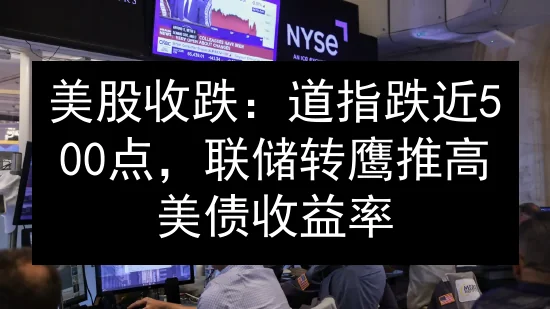
Wall Street Falls: Dow Drops Nearly 500 Points as Hawkish Fed Lifts Yields
Beijing time June 18 morning, Wall Street fell Wednesday, with the Dow dropping about 500 points. Big tech stocks led declines, Treasury yields surged. Several Fed officials hinted at possible rate hikes this year to curb inflation, leaving investors uncertain about the monetary policy path.
The Dow fell 507.12 points, or 0.98%, to 51,492.55 points, after hitting an intraday record earlier in the session for the third straight day. The Nasdaq fell 354.68 points, or 1.34%, to 26,021.65 points. The S&P 500 fell 91.25 points, or 1.21%, to 7,420 points.
Big tech stocks led declines, with Microsoft, Meta Platforms, Alphabet, and Amazon all down. Hot IPO SpaceX also dampened sentiment, falling for the first time since its IPO on Friday. Chip stocks like Intel and Micron rose, helping curb some of the broader market decline.
This was the first Fed meeting chaired by new Chair Kevin Warsh. After the two-day meeting, the Fed kept rates unchanged at the 3.5% to 3.75% target range.
According to the Summary of Economic Projections, several Fed officials expect rate hikes in 2026. The median year-end federal funds rate estimate is now 3.8%, up from 3.4% in the March forecast, suggesting the committee sees at least one rate hike needed in 2026.
Warsh revealed he did not submit an interest rate forecast, adding complexity to the outlook.
Treasury yields jumped after the decision, with the 2-year yield rising 16 basis points to 4.208%.
"The market reaction so far is mostly about the dot plot... it's much more hawkish," said Claudia Sahm, chief economist at New Century Advisors. "The inflation picture has changed a lot."
Traders also focused on Warsh's several mentions of the Fed's commitment to 'price stability' in the press conference, hinting he may not deliver rate cuts as many expected from a Trump nominee.
Jeffrey Gundlach, CEO of DoubleLine Capital, said: "He is absolutely telling you he plans to achieve price stability. That means... we are not going to have the loose monetary policy that was expected under Chairman Warsh when everyone was betting on rate cuts in the first quarter. He sounds nothing like that today."