2026 Hong Kong IPO Market Continues Strong: Technology and "A+H" Dual Engines Drive, Chinese Sponsor Dominance Takes Shape
Keywords
HK IPO; tech companies; A+H listing; sponsor market; Chinese securities firms; repricing
Introduction
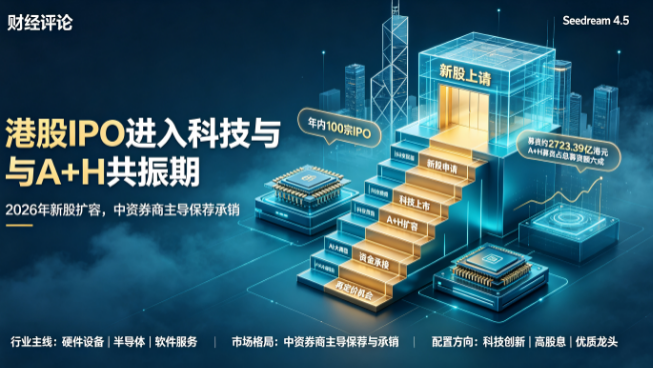
Since 2026, the Hong Kong IPO market has continued its strong momentum, showing structural optimization and capital concentration. According to HKEX data, as of June 30, 2026, 373 new listing applications were received, plus 372 carried over from end-2025, totaling 745 in the pipeline, with 528 under processing. Wind data further shows that as of July 28, the year saw 100 IPOs completing on the HK market, raising approximately HK$272.339 billion. Analysts believe that with mainland tech leaders accelerating their Hong Kong listings and the continuous deepening of the cross-border connectivity mechanism, Hong Kong's position as the preferred listing destination for new economy companies will be further consolidated. This article will analyze the latest dynamics of the 2026 HK IPO market from three dimensions: the dual engines of IPO expansion, the evolution of the sponsor market landscape, and the outlook.
Technology and "A+H" Dual Engines Drive IPO Expansion
The batch listing of tech companies and the acceleration of the "A+H" model constitute the two core features of the 2026 HK IPO market. Lyu Zhihong, Partner in charge of Southern China Region, Deloitte China Capital Markets Services, pointed out that the HK market structure continues to optimize, with a group of companies in semiconductors, AI supply chain, robotics, biotechnology, as well as hard-tech companies from the A-share market concentrating on Hong Kong listings. These companies accounted for over 70% of the total number of new stocks in Hong Kong in the first half of 2026, and nearly 80% of the total funds raised.
According to Wind industry classification, 21 hardware equipment companies were listed, with IPO fundraising of approximately HK$104.75 billion, accounting for about 38.5%; 14 semiconductor companies, raising about HK$52.206 billion, accounting for 19.2%; and 15 software services companies, raising about HK$27.994 billion. The combined fundraising of these three sectors accounted for about 70% of total. These figures confirm the dominant role of tech companies as the core of HK IPOs.
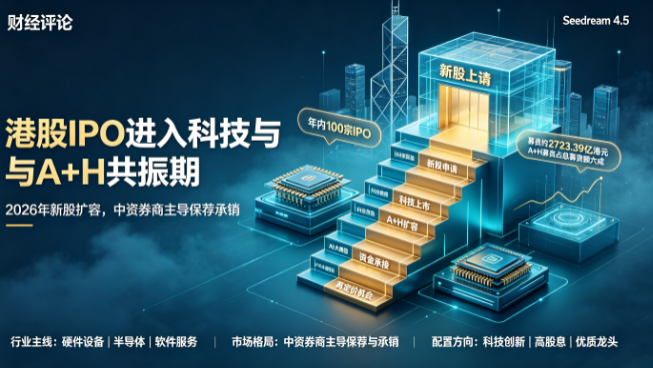
Meanwhile, the accelerated expansion of the "A+H" listing model has become a core engine driving up overall fundraising scale. Wind data shows that as of July 28, 31 A-share listed companies had landed on HKEX during the year, with total initial fundraising of HK$173.61 billion, accounting for 60% of total HK IPO fundraising for the year. KPMG data shows that in the first half of 2026, there were 24 "A+H" listings in Hong Kong, exceeding the full-year 2025 total of 19, with "A+H" projects accounting for 58% of first-half HK IPO fundraising. Industry insiders believe that the "A+H" listing wave stems both from the practical need for mainland tech companies to globalize and from the continuous deepening of Hong Kong-mainland connectivity mechanisms. As HKEX continues to optimize listing rules, more tech companies in frontier fields such as AI, semiconductors, and smart driving are expected to list in Hong Kong, further expanding the "A+H" camp.
Sponsor Market Shows Chinese Dominance
Against the backdrop of continuous expansion of the HK IPO market, the sponsor market landscape has shown a clear Chinese dominance. In terms of number of sponsors, Wind data shows that as of July 28, 40 institutions have participated as sponsors in HK IPO projects this year. CICC (International) topped the list with 35 IPO projects, holding a market share of 18.42%; CITIC Securities (International) ranked second with 24 projects and 12.63% share; Huatai Financial Holdings was third with 14 projects and 7.37% share; Guotai Junan (Hong Kong) was fourth with 10 projects and 5.26% share.
In terms of underwriting scale, CICC (International) led with an underwriting amount of HK$69.6 billion, occupying 25.25% market share; CITIC Securities (International) was second with HK$31.546 billion and 11.44% share; Huatai Financial Holdings was third with HK$22.35 billion and 8.11% share; Goldman Sachs (Asia) was fourth with HK$15.329 billion and 5.56% share. Overall, Chinese securities firms have taken a dominant position in both sponsorship and underwriting, with a clear trend of industry concentration and resources flowing to large Chinese brokerages.
This pattern has formed partly because mainland tech companies prefer Chinese sponsors familiar with their business models, and partly due to the unique advantages of Chinese brokerages in cross-border underwriting and mainland network resources. Meanwhile, international investment banks still hold significant positions due to their brand effect and institutional resources in global capital markets, but their market share has been substantially surpassed by Chinese institutions.
Quality Leaders Expected to Achieve "Repricing"
Looking ahead, the HK IPO project pipeline is ample, and the market generally expects the issuance momentum to continue. Lai Yeye, Chief Strategy Analyst at SPDB International, said that since 2026, semiconductor and other AI hardware companies have accelerated their listings, reflecting enterprises' urgent need to expand international financing channels. As more large "A+H" projects and hard-tech companies list in Hong Kong, the industry structure and investor composition of the HK market will continue to improve. The sustained enhancement of the Stock Connect inclusion effect and continued southbound capital inflows will provide solid liquidity support for the HK market.
In terms of market capital absorption capacity, Li Jian, Chief Analyst of Non-bank Financials at Huatai Securities, pointed out that against the backdrop of overseas market volatility, Hong Kong's appeal has increased, and high-quality IPO projects continue to expand. The average daily turnover of Hong Kong stocks in the second quarter hit a record quarterly high of HK$289.5 billion. The main driver of this turnover record is the increasing number of mainland leading enterprises and tech companies choosing to list in Hong Kong.
Xu Guanghong, Chief Overseas Strategy Analyst at CITIC Securities, believes that in the second half of the year, Hong Kong stocks are facing a rare IPO queue and huge lock-up expiration pressure in recent years. However, fundraising peaks are often byproducts of rising market risk appetite rather than decisive factors for market reversal. Under specific macroeconomic conditions, large-scale financing may actually attract foreign capital inflows, increase buying orders, prompt the HKMA to inject liquidity into the market, and depress HIBOR. Xu Guanghong said that lock-up expirations are more of a structural risk than a systemic market suppressor; historically, the impact of large-scale expirations has been mostly confined to individual stocks and sectors, without a comprehensive shock to the Hang Seng Composite Index. In terms of strategy, he suggested investors allocate to high-dividend assets and quality leaders, while being cautious of small-cap stocks with expiration ratios exceeding 15% and lacking liquidity support.
From the perspective of new stock investment opportunities, sector return divergence will further intensify. Based on complete new stock trading data for the first half of the year, HK new stocks have formed a clear pattern of "strong tech, weak traditional." The AI hard-tech track has significant advantages in both IPO subscription returns and long-term holding returns. Yang Chao, Chief Strategy Analyst at China Galaxy Securities, believes that the inflection point in Hong Kong stocks' fundamentals has been confirmed, but market confidence and capital flows have not yet converged. Hong Kong stocks are currently at relatively low valuations with long-term upside potential and are still in a buildup phase.
Conclusion
The 2026 HK IPO market has expanded under the dual drive of tech companies and the "A+H" model, further consolidating the dominant position of Chinese sponsors. Looking ahead, despite lock-up expiration pressures and fundraising peaks, the "repricing" opportunities for quality leaders deserve attention. In terms of allocation, Yang Chao recommends focusing on technological innovation themes and dividend themes: technological innovation will be the core investment theme for Hong Kong stocks. As the AI trend spreads from pure hardware to computing power leasing, cloud services, semiconductors, humanoid robots, MaaS services, and the full supply chain, the structural disadvantage of Hong Kong stocks may gradually transform into a relative advantage. On the dividend assets side, REITs, telecom services, consumer dividend and utility sectors, with their combination of high dividend yields, stable price performance, and improving ROE, are becoming the most cost-effective investment options. Overall, the Hong Kong IPO market is entering a new phase of structural optimization and quality improvement, bringing abundant allocation opportunities for investors.