Policy Implementation: HK Dividend Tax Welcomes Historical Reduction
On August 4, 2026, according to sources close to the regulatory authorities, the mainland and Hong Kong securities regulatory commissions and tax departments have reached an agreement on the HK Connect dividend tax reform plan, which is expected to be formally implemented within the year. The core of this reform is that the personal income tax rate for dividends received by mainland individual investors investing in Hong Kong listed companies through HK Connect will be significantly reduced, and may even be completely exempted, equivalent to Hong Kong local residents.
For a long time, dividend tax has been an invisible barrier between mainland investors and HK high-dividend assets. According to the current regulations, mainland investors who buy HK stocks through HK Connect need to pay a 20% dividend tax (or 10% if the listed company does not issue bonus shares), while Hong Kong local investors are completely exempt. This leads to the fact that for the same high-dividend stock, the actual cash flow return for mainland investors is significantly lower than that of Hong Kong local investors, which invisibly suppresses the willingness of southbound funds to allocate to the high-dividend sector.
Once this reform is implemented, it will completely remove this institutional bottleneck. The CEO of HKEX hinted at the mid-year results press conference: "We are closely cooperating with mainland partners to eliminate unnecessary friction costs of cross-border investment under the principle of tax neutrality." Now, this vision is about to become a reality.
HK High-Dividend Sector Valuation Logic Reconstruction
In the HK market, the high-dividend strategy has long been the core allocation direction for institutional investors. Taking the Hang Seng High Dividend Yield Index as an example, its components include mainland banking stocks, public utilities, energy and some real estate leaders, which generally have abundant cash flow, stable dividend ratios, and dividend yields higher than 4%. However, due to the 20% dividend tax eroding a large amount of returns, mainland southbound funds often tend to chase tech growth stocks or short-term band operations rather than long-term holding high-dividend stocks to eat dividends.
Once the dividend tax is reduced, the attractiveness of HK high-dividend assets will undergo a qualitative change. Taking a Hang Seng Index component with a dividend yield of 6% as an example, after deducting 20% tax, the actual return is only 4.8%; after tax exemption, this 1.2 percentage point difference will be directly converted into excess returns. In the current global low-interest rate environment and "asset shortage" background, this return advantage is enough to attract hundreds of billions of long-term funds to sweep southbound.
Market analysts point out that the first beneficiaries will be mainland large banking stocks (such as CCB, ICBC, BOC), three major telecom operators (such as China Mobile, China Telecom) and some Hong Kong local public utility stocks. These targets not only have high dividend yields, but also have stable business operations, in line with the aesthetic preferences of long-term funds such as insurance funds and pension funds.
Southbound Fund Structure May See a Turning Point
Looking back at the first half of 2026, the cumulative net inflow of southbound funds has exceeded 350 billion Hong Kong dollars, but the capital flow shows obvious "technology preference"—a large amount of capital has flowed into tech stocks such as Tencent, Meituan, Xiaomi, while mainland banking stocks and high-dividend public utility stocks have inflows, but the scale is relatively limited. The dividend tax reform will most likely change this pattern.
A fund manager who declined to be named said: "In the past, when we allocated HK dividend assets, we needed to compare after-tax returns with similar assets in the A-share market. If A-share high-dividend stocks are more attractive after considering new issue subscription income and tax benefits, we will underweight HK. Now that HK dividend tax is cancelled, not only is the disadvantage eliminated, but because HK valuations are generally lower than A-shares, a clear comparative advantage has emerged."
In addition, insurance funds, social security funds and other absolute-return institutions will also be the biggest winners of this reform. This type of funds has a high dependence on dividend income and a long investment period, with relatively low requirements for liquidity. The dividend tax reduction will greatly enhance the weight of HK high-dividend assets in the strategic allocation of insurance funds. It is expected that in the next six months, the scale of insurance funds increasing high-dividend stocks through HK Connect may exceed 50 billion Hong Kong dollars.
Linked Exchange Rate System Plus Tax Advantages: New Anchor Point for Global Capital
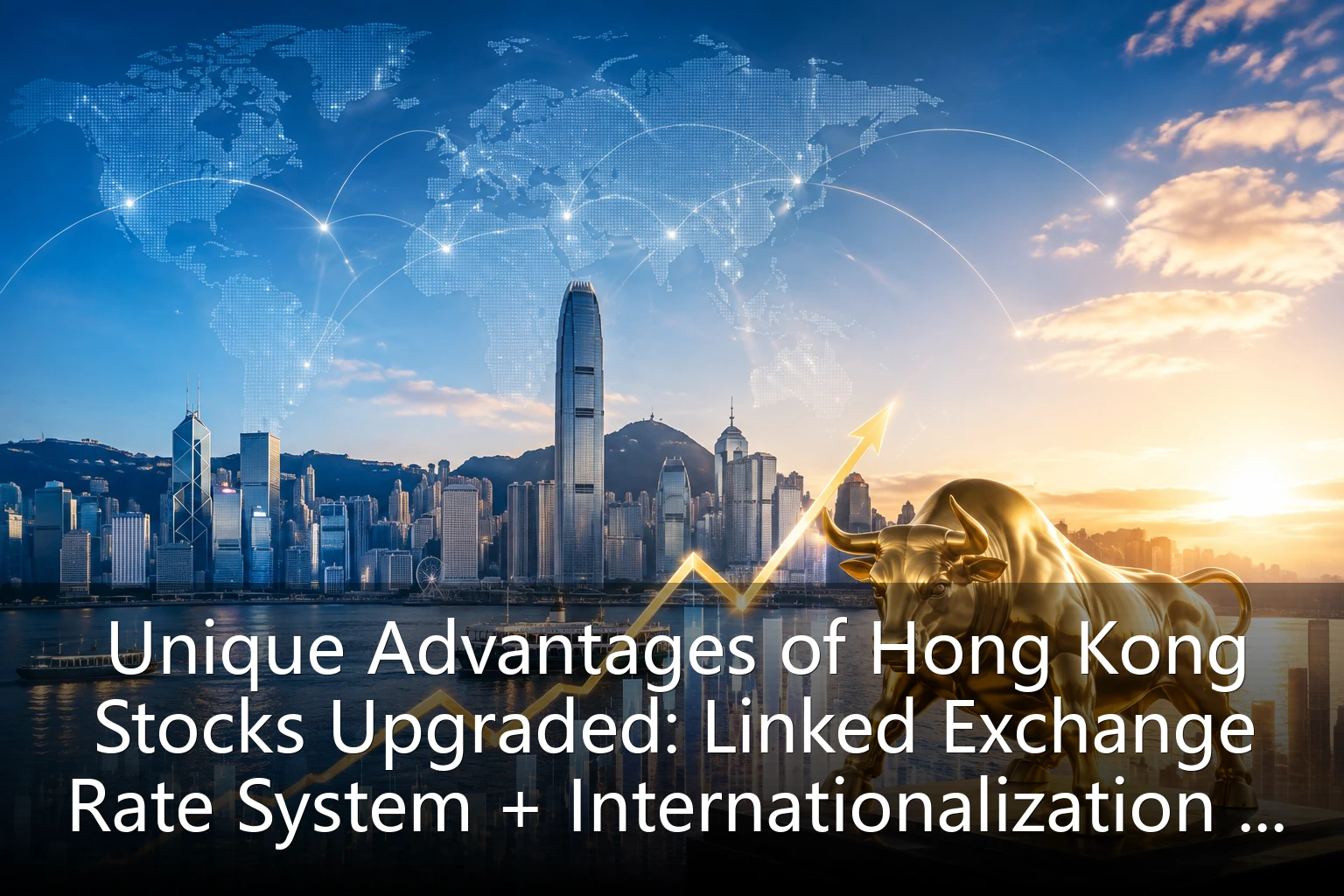
Looking at the global picture, HK's unique linked exchange rate system has long made it a safe haven for international capital. The Hong Kong dollar is pegged to the US dollar, meaning that holding HK assets naturally has the ability to resist exchange rate risk in emerging markets. Now, with the launch of the dividend tax reduction policy, the attractiveness of HK to international investors will be further enhanced.
For international pension funds and sovereign funds, the gold content of HK high-dividend blue chips is rapidly increasing. In the context of sudden tightening of financial supervision in the US and Europe and global capital seeking stable returns, HK's "dollar peg + tax-free dividends + low valuation" triple advantages are becoming a new anchor point for global capital allocation. Some European institutional investors have begun to re-evaluate the allocation value of HK high-dividend assets, believing that this is a rare global market existence in the developed market framework but with emerging market returns.
Trading Mechanism Support: T+0 and Short Selling System Empower Dividend Strategy
HK's unique trading mechanism also provides more practical tools for the dividend strategy after the dividend tax reduction. Unlike the A-share market, HK implements T+0 trading and has a mature short selling mechanism. This means that when investors build strategies around high-dividend stocks, they can flexibly use hedging methods. For example, buying high-dividend stocks before the ex-dividend date to get dividends, while short selling Hang Seng Index futures or buying put options to hedge systematic risks, thereby achieving a more pure dividend arbitrage strategy.
In addition, HKEX's new generation trading system has been fully online this quarter, with significantly improved trading speed and capacity, which provides technical guarantee for professional investors to execute complex multi-leg arbitrage strategies. It can be predicted that with the implementation of dividend tax reduction, quantitative hedging strategies around HK high-dividend assets will usher in a round of explosive growth.
Conclusion: HK Core Attraction Evolves Again
From the linked exchange rate system to T+0 trading, from the short selling mechanism to the internationalized investor structure, the HK market has always been known for its institutional flexibility and open inclusiveness. Now, the completion of the dividend tax reform has made up the last shortcoming—the substantial improvement of mainland investors' income rights.
This is not just a minor adjustment of tax policy, but a reconfirmation of Hong Kong's position as China's offshore financial center and a hub connecting mainland China and global capital. For long-term investors seeking stable returns, the HK high-dividend sector is standing at the dual风口 of policy dividends and valuation recovery. In the 2026 second half investment map, HK dividend assets have undoubtedly become an important direction that cannot be ignored.