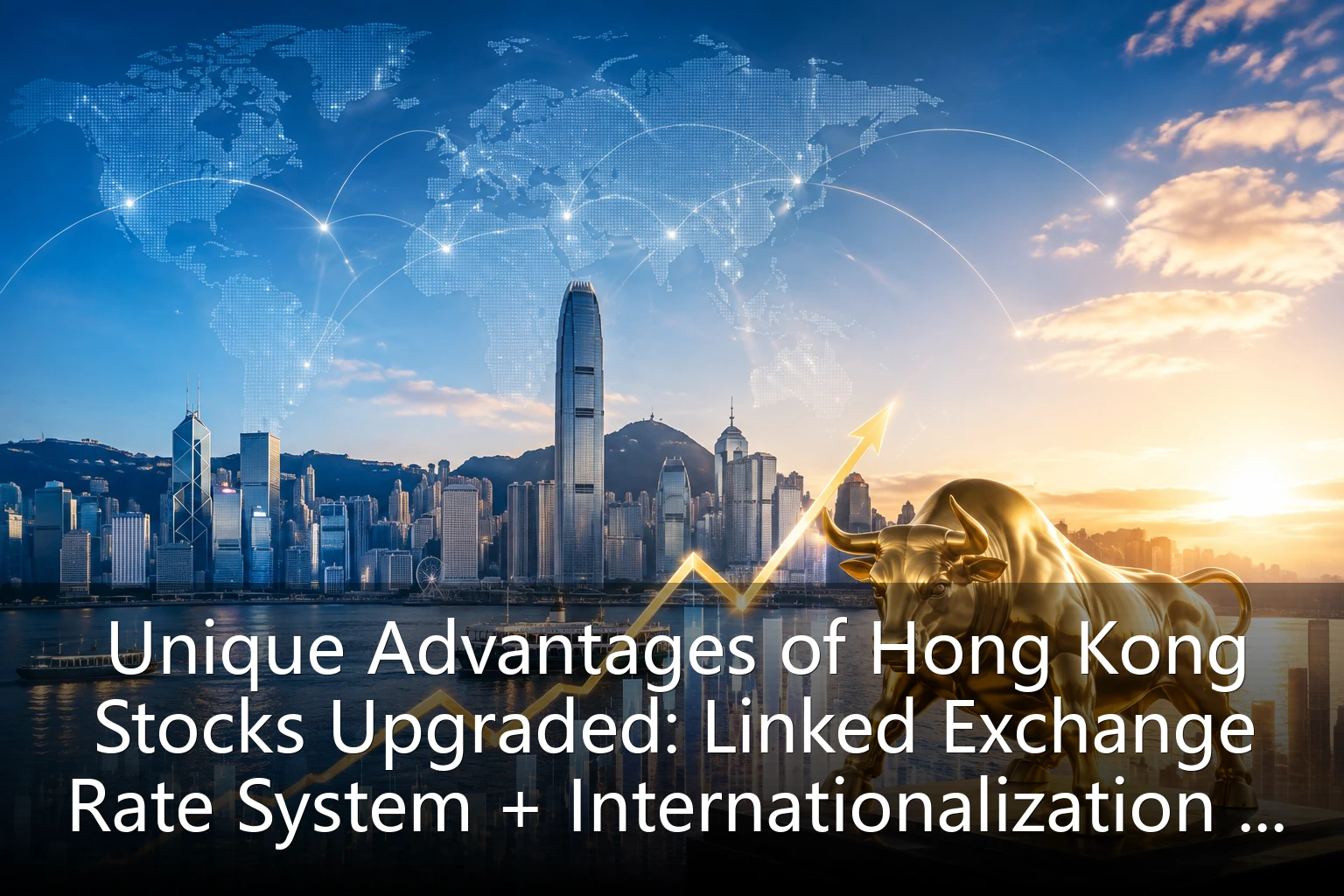
In July 2026, global financial markets frequently fluctuated amid persistent inflation and geopolitical tensions. U.S. stocks came under pressure due to weaker-than-expected economic data, while emerging market currencies experienced sharp volatility as the U.S. dollar strengthened. However, the Hang Seng Index in Hong Kong rallied against the trend, gaining about 2.5% in the first three weeks of July, with average daily turnover recovering to over HKD 150 billion. Market analysts believe that Hong Kong stocks are once again becoming a “safe haven” for global capital, and the core attraction lies in the currency stability provided by the linked exchange rate system, as well as a market ecosystem highly aligned with international rules.
Linked Exchange Rate: The “Hard Anchor” Between the Hong Kong Dollar and US Dollar
Since 1983, Hong Kong has implemented a linked exchange rate system, locking the HKD-USD rate within a narrow band of 7.75 to 7.85. This mechanism withstood the test of the 1998 Asian Financial Crisis, the 2008 Global Financial Tsunami, and the 2020 pandemic shock. The Hong Kong Monetary Authority maintains the stability of the Hong Kong dollar through an automatic interest rate adjustment mechanism and foreign exchange reserve intervention. As of July 2026, Hong Kong's foreign exchange reserves exceeded USD 440 billion, over 1.7 times the monetary base, providing solid backing for the linked exchange rate.
For international investors, the low volatility of the Hong Kong dollar means manageable exchange rate risk. In an environment of competitive currency depreciation globally, investing in Hong Kong stocks avoids the exchange losses common in emerging markets. This is particularly critical during a high-interest-rate cycle in the U.S.—even if companies are priced in HKD, their cash flows and asset values remain relatively stable relative to USD assets, reducing uncertainty in cross-border arbitrage.
International Market: A Convergence of Global Capital and Diverse Assets
Hong Kong Exchanges and Clearing (HKEX) is one of the most internationalized major exchanges globally. Data shows that overseas institutional investors account for over 40% of the Hong Kong stock market on a regular basis, with mainland capital entering through the Stock Connect channel accounting for about 15%, and the rest coming from Europe, the U.S., the Middle East, and other parts of Asia-Pacific. This diversified investor structure makes Hong Kong stock pricing more rational and less susceptible to sentiment from any single market.
As of mid-July 2026, the total number of listed companies on HKEX exceeded 2,600, with a total market capitalization of about HKD 40 trillion. Industry distribution covers key sectors such as finance, technology, consumer goods, healthcare, and real estate. Among them, the market capitalization share of new economy companies (e.g., biotechnology, artificial intelligence, new energy) has risen from 20% five years ago to 35%. This structure not only offers abundant investment opportunities but also positions Hong Kong stocks in a dual role of “China growth + global liquidity” in global asset allocation.
Flexible Trading Mechanisms: T+0, Short Selling, and Derivatives
Compared with the A-share market, Hong Kong stocks offer significant flexibility in trading mechanisms. Hong Kong stocks allow T+0 round-turn trading, meaning stocks bought on the same day can be sold within the same trading session, facilitating high-frequency trading and risk management. Meanwhile, short selling is permitted (subject to obtaining securities lending qualifications), and there is a rich array of derivative instruments (e.g., index futures, options, warrants, CBBCs). These tools are especially important in one-sided downtrends or volatile markets—institutional investors can reduce portfolio fluctuations through hedging rather than simply withdrawing capital.
Additionally, Hong Kong stock trading hours cover 9:30 a.m. to 4:00 p.m. (with a lunch break from 12:00 p.m. to 1:00 p.m.), partially overlapping with mainland market hours, enabling cross-border investors to operate in real time. In recent years, HKEX has also optimized the closing auction mechanism and introduced the $HKD-RMB Dual Counter$ model, further reducing transaction costs for southbound capital.
Dividend Tax and Yield Advantage: Appeal for Long-Term Investors
Although the dividend tax (withholding tax) for Hong Kong stock investors varies by investor type (individual investors typically pay 10% withholding tax, while some countries enjoy preferential rates under tax treaties), Hong Kong companies generally have a higher dividend payout ratio than A-shares and U.S. stocks. According to Bloomberg data, the Hang Seng Index’s trailing 12-month dividend yield is about 3.8%, higher than the S&P 500’s 1.5% and the Shanghai Composite Index’s 2.3%. For funds seeking stable cash flows (such as pension funds and REIT investors), the high dividend characteristic of Hong Kong stocks is an important allocation reason.
Moreover, Hong Kong has no capital gains tax (except for specific transactions) and does not impose additional income tax on dividends (only withholding tax), making the overall tax environment favorable. This gives Hong Kong stocks a cost advantage in long-term holding strategies.
Stock Connect Deepens Interconnection
Since the launch of the Shanghai-Hong Kong Stock Connect in 2014, the interconnection mechanism between the two markets has been continuously improved. As of July 2026, the daily quota for Stock Connect has been expanded to RMB 56 billion (southbound) and RMB 42 billion (northbound), and has added targets such as the STAR Market and ChiNext. Mainland investors can enjoy reductions in commissions, stamp duty, and other fees through Stock Connect, and are not subject to foreign exchange quota restrictions (although actually constrained by the annual personal USD 50,000 limit, this can be indirectly circumvented through broker institutions).
Notably, the Stock Connect mechanism has also promoted RMB internationalization—some Hong Kong stock transactions can be directly quoted and settled in RMB, reducing the impact of exchange rate fluctuations on mainland investors. Recently, HKEX announced that it will study the “HKD-RMB Dual Counter Market Maker Plan,” which is expected to further enhance liquidity.
Risks and Outlook: Not Without Shortcomings
Although Hong Kong stocks have many advantages, investors should be aware of risks: on one hand, Hong Kong stocks are highly influenced by overseas liquidity—if the Federal Reserve continues to raise interest rates, rising HKD funding costs may suppress valuations; on the other hand, Hong Kong’s economy is relatively small, and the performance of local listed companies is susceptible to global trade and geopolitical shocks; additionally, the frequent occurrence of “penny stocks” and changes in the regulatory environment (such as the discussion on delisting of Chinese concept stocks) are potential disturbance factors.
However, from a long-term perspective, Hong Kong stocks’ role as a hub connecting mainland China and global markets is irreplaceable. In the second half of 2026, as China’s steady growth policies continue to take effect and expectations of a peak in the U.S. economy heat up, Hong Kong stocks are likely to attract more medium-to-long-term capital under the valuation trough effect. For global asset allocators, understanding and leveraging the unique advantages of Hong Kong stocks will be an important part of navigating market cycles.
(This article is compiled based on public information and does not constitute investment advice.)